Skip to page content

AY2027 Registration Is Now Open! Try 4 Lessons
from Just $99. Enquire Now

GOT A QUESTION? Chat with a real person now.

WhatsApp Us

Primary 3 Maths
Tuition in Singapore

Learn to work through problem sums, one strategy at a time. Our Primary 3 Maths tuition in Singapore develops model drawing and named heuristics alongside larger numbers, fractions, new geometry topics, and area and perimeter.

No upfront deposit & registration fees

Preview Our P3 Maths WorksheetsEnquire Now
Student writing on a worksheet in an AGrader classroom4 trial lessons promotion

AY2027 Trial Class Promotion

Primary 3 Math

MathP1–P6

  • No registration fee
  • No upfront deposit

Free EverLoop after-class revision included.

$129

for 4 lessons

Enquire Now

Fees are subject to 9% GST. Promotion valid for registrations from 7 September 2026 onwards.

AGrader Math programme

How Our Maths Tuition for Primary 3
Supports Your Child

Primary 3 brings a bigger step into problem solving. Children need to choose a method as well as calculate accurately. Our Maths tuition for Primary 3 gives them guided practice with comparison, working backwards, before-and-after and other named strategies, helping them connect the information in a question with a model and clear written steps. This course is part of our Primary Math programme, covering P1–P6.

2 hoursper weekly lesson
Maximum 12students per class
EverLoopafter-class revision included

The AY2027 Primary 3 Learning Programme

What Your Child Will Learn in Primary 3 Math

The Primary 3 Maths syllabus extends numbers to 10 000 and introduces angles, parallel and perpendicular lines, area and perimeter, and bar graphs. Model drawing and problem-solving strategies connect these five learning areas, with hands-on materials supporting new concepts.

Five Key Learning Areas

Larger Numbers & Operations

Build accuracy with larger calculations and apply them to word problems.

  • Numbers to 10 000, with addition and subtraction of larger numbers
  • The 6, 7, 8 and 9 times tables
  • Multiply numbers using multiplication workings, beyond the times tables
  • Dividing numbers using long division workings

Models & Problem Solving

Learn named strategies and practise choosing one to match the problem.

  • Part-Whole and Comparison Models
  • Working Backwards, Before-and-After, and Guess and Check
  • Gaps & Intervals
  • Grouping, Sharing and other multiplication and division strategies

Fractions

Use fraction discs and written methods to understand and calculate with fractions.

  • Equivalent fractions and comparing fractions
  • Adding and subtracting fractions
  • Part-Whole Fractions in problem solving

Geometry, Area & Perimeter

Explore new geometry ideas and distinguish the space inside a figure from its boundary.

  • Angles compared with a right angle
  • Parallel and perpendicular lines
  • Area and perimeter with an area-and-perimeter kit

Everyday Measurement & Data

Apply calculations to quantities, money, time and information shown in graphs.

  • Length, mass, volume and time
  • Adding and subtracting money, including word problems
  • Reading bar graphs

A Wider Problem-Solving Toolkit

Connect Each Problem with a Method

Dedicated problem-solving lessons build a wider range of strategies than in P2. Children study a worked example, try the method and review their working. These groups show the models and concepts they practise across P3.

Parts & Comparisons

Part-Whole & Comparison Models

Children use the Part-Whole Model and Comparison Model in addition and subtraction, then revisit comparison in multiplication and division. The Multiplicative Comparison Model helps represent quantities related by multiplication.

Following a Change

Working Backwards & Before-and-After

Working Backwards starts from the result and retraces the steps. Before-and-After models show quantities as they change, including Internal Transfer problems where an amount moves from one person or group to another.

Groups, Totals & Sharing

Grouping, Finding the Total & Sharing

Children practise Grouping, Finding the Total and Sharing in multiplication and division problems. Gaps and Intervals introduces questions where the number of spaces and the number of objects need careful attention.

Testing & Representing

Guess and Check & Part-Whole Fractions

Guess and Check gives children a structured way to test possible answers. Part-Whole Fractions connects the model to fraction problems, alongside adding and subtracting fractions.

Applying What They Learn

From Recognising a Strategy to Explaining the Steps

P3 problem solving goes beyond following a calculation. Worked examples show the model, underline key information and set out numbered steps. Children attempt practice questions independently, then review each question with the teacher. A summary page brings the strategy together with a sample question, while Heuristic Packs on EverLoop offer further practice with the concepts taught.

THE LEARNING GOALS

By the End of Primary 3

Develop a wider range of methods for problem sums and confidence with new P3 topics.

Our lessons build towards these skills for your child:

  • Work with numbers to 10 000 and use the 6, 7, 8 and 9 times tables.
  • Choose and draw a suitable model for a word problem.
  • Solve multi-step problems using strategies such as Before-and-After, Guess and Check, and Working Backwards.
  • Compare fractions, recognise equivalent fractions, and add and subtract fractions.
  • Find area and perimeter, recognise new geometry concepts and read bar graphs.
AGrader Primary Math learning-resource preview

Learning Resources Preview

Preview Our Primary 3 Maths Worksheets

Preview our Primary 3 Math worksheets and learning materials to see how concepts, worked examples and practice are presented. The P3 download below opens the materials preview linked from our Primary Math programme page.

Download P3 Math

Inside the Classroom

What to Expect from Our P3 Maths Tuition

Our P3 Maths tuition class meets for one two-hour lesson each week across four terms and a 50-week programme, with a maximum of 12 students. In AY2027, the additional lesson time supports more problem-solving practice and interactive teaching.

01

Make the Concept Visible

A multiplication board, fraction discs and an area and perimeter kit are hands on activities to help children learn new ideas effectively. Notes connect these experiences with the method they will use in written questions.

02

Study the Model & Method

A worked example shows how to read the problem, represent the quantities and organise the solution. Numbered steps and tips help children follow the reasoning behind each strategy.

03

Practise Independently & Review

Children attempt the questions before the teacher goes through each one with the class. Worked solutions show method and answer marks, helping children understand the steps as well as the final answer.

04

Consolidate with Summaries & Drilling

Lessons usually include a Kahoot! or Wordwall game and end with a summary. From AY2027, each worksheet includes a 12-mark drilling section of short exam-style questions, with correct answers earning Bonus Bucks.

Revision with Follow-up

Topical Practice and termly Revision Papers revisit the topics taught. Diagnostic Tests in Terms 2 and 4 each have a go-through lesson for corrections and re-teaching.

Revisit a Difficult Method

Summary Cheat Sheets, Topical Quizzes and Revision Quizzes support revision. QR-linked teaching videos and walkthrough videos for harder questions and drilling sets help children check the steps at home.

Keep Learning Between Lessons

A weekly lesson summary tells parents what was covered and what to finish at home. EverLoop provides further revision and heuristic practice, while LessonTube recordings support missed lessons.

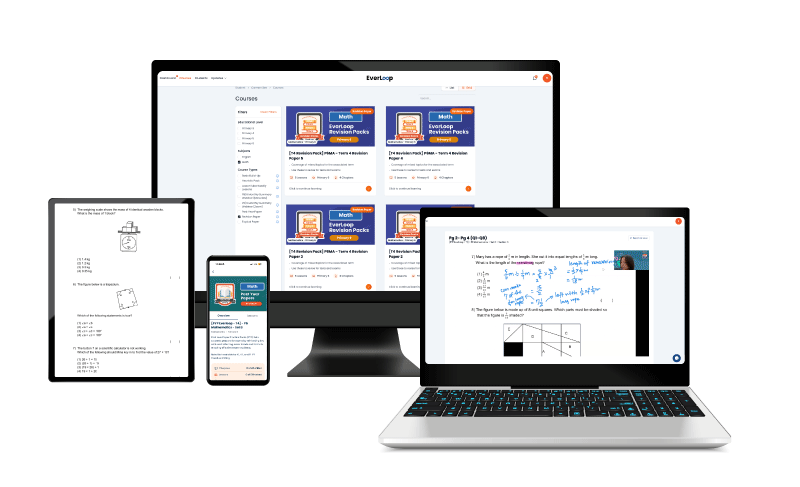
EverLoop revision resources shown across several devices

EverLoop After-Class Revision System
Complimentary with Every Enrolment

Primary Math students receive five EverLoop modules at no additional charge, alongside weekly lessons and AGrader’s in-house worksheets.

Past Year Paper Practice Packs (PYP)

Past Year Paper Practice Packs (PYP)

› To Practise Question Formats & Answering Techniques

Practice papers, teaching videos and detailed solutions give children more opportunities to revisit question types and check their working.

Basic Build-Up

Basic Build-Up

› To Strengthen Fundamental Concepts

Specially developed practice questions help children revisit core Mathematics concepts and strengthen their foundations.

Revision Packs

Revision Packs

› To Revisit Each Term’s Learning

Term-specific revision covers topics taught in Terms 1–4, giving children opportunities to identify gaps and practise weaker areas.

Topical Packs

Topical Packs

› To Practise a Specific Topic

Targeted practice papers and teaching videos offer additional explanations and practice for topics your child wants to revisit.

LessonTube

LessonTube

› To Catch Up or Revisit a Lesson

Lesson recordings let children return to missed lessons or revisit what was taught after enrolment.

Learn More

Meet Our Primary Math Curriculum Team

Teacher Felicia Tham

Teacher Felicia Tham

Felicia is a Math teacher and curriculum writer at AGrader. She graduated from the National University of Singapore with a double major in Economics and Psychology. With 10 years of teaching experience, Felicia is well versed in the primary Math syllabus. She has helped her students excel by helping them understand the problems in a systematic and clear manner. She is also well-liked by her students for being caring and patient.

Don’t Just Take Our Words For It
Check Out What Other Parents Said About Us

Enquire Now

Academic Year 2027 · Fees & Schedules

Find a P3 Maths Tuition Centre Near You

Looking for a Primary 3 Maths tuition centre in Singapore? Explore AGrader locations, check fees and schedules, and ask about available P3 classes at your preferred branch.

AGrader centre location map

Frequently Asked Questions

Useful answers about the curriculum, weekly lessons and home practice.

What does the Primary 3 Maths syllabus cover?

The P3 programme covers numbers to 10 000, larger calculations, the 6, 7, 8 and 9 times tables, fractions, money, time, length, mass and volume. New topics include angles compared with a right angle, parallel and perpendicular lines, area and perimeter, and bar graphs. Model drawing and named problem-solving strategies are taught alongside these topics.

Which problem-solving heuristics do children learn in P3 Math?

Children practise the Part-Whole Model, Comparison Model, Multiplicative Comparison Model, Working Backwards, Before-and-After, Internal Transfer, Grouping, Finding the Total, Sharing, Gaps and Intervals, Guess and Check, and Part-Whole Fractions. Teachers explain each method with a worked example before children try it and review the questions together.

How is Primary 3 Maths different from Primary 2?

P2 introduces the first models for part-whole, comparison, multiplication and sharing problems. P3 develops a wider set of strategies and more multi-step problem solving, alongside larger numbers, more fraction work and new geometry and measurement topics. Lessons give children practice recognising which method fits the question.

How long is each Primary 3 Maths lesson, and what is the class size?

Children attend one two-hour lesson each week across four terms and a 50-week programme. Each class has a maximum of 12 students. In AY2027, the additional P3 lesson time is used for more problem-solving practice and interactive teaching.

Does the programme include Primary 3 Math exam papers and revision?

Children work with termly Revision Papers and have Diagnostic Tests in Terms 2 and 4, each followed by corrections and re-teaching. From AY2027, worksheets also include a 12-mark drilling section of short exam-style questions. EverLoop Revision Packs and Past Year Paper packs provide further opportunities to practise beyond the lesson.

How can my child revisit a P3 Maths method at home?

The weekly lesson summary identifies what was covered and what to finish at home. Your child can revisit Summary Cheat Sheets, quizzes and QR-linked teaching videos, and use walkthrough videos to check harder questions and drilling sets. EverLoop includes further heuristic practice, while LessonTube recordings support missed lessons.

Can I preview your Primary 3 Maths worksheets?

Yes. Use Download P3 Math in the learning-resources section to open the P3 Maths worksheets and materials preview linked from our Primary Math programme page.

Where can I find a P3 Maths tuition centre in Singapore?

Use Find a Centre to explore AGrader locations, then check View Fees & Schedules or enquire about P3 Maths tuition at your preferred branch. Preview the learning materials and ask about trial lessons before choosing a Primary 3 Maths tuition centre.

Let’s Talk About Your Child’s Next Step

Ask about the programme, current class availability and your preferred AGrader centre.

Enquire Now