Skip to page content

AY2027 Registration Is Now Open! Try 4 Lessons
from Just $99. Enquire Now

GOT A QUESTION? Chat with a real person now.

WhatsApp Us

Primary 4 Math
Tuition in Singapore

More ways to solve problem sums, plus decimals, angles and data. Our Primary 4 Maths tuition helps your child choose a model, explain the working and apply new concepts through weekly two-hour lessons.

No upfront deposit & registration fees

Preview Our P4 Maths WorksheetsEnquire Now
Student using a ruler to draw a model on a Maths worksheet4 trial lessons promotion

AY2027 Trial Class Promotion

Primary 4 Math

MathP1–P6

  • No registration fee
  • No upfront deposit

Free EverLoop after-class revision included.

$129

for 4 lessons

Enquire Now

Fees are subject to 9% GST. Promotion valid for registrations from 7 September 2026 onwards.

AGrader Math programme

How Our Maths Tuition for Primary 4
Supports Your Child

P4 brings larger numbers, more demanding fraction problems and a first look at decimals. Our Maths tuition for Primary 4 connects these topics through clear worked examples and model drawing. Children practise whole-number heuristics, carry the unit model into fractions and learn different ways to approach area and perimeter problems, building towards P5. This course is part of our Primary Math programme, covering P1–P6.

2 hoursper weekly lesson
Maximum 12students per class
EverLoopafter-class revision included

The AY2027 Primary 4 Learning Programme

What Your Child Will Learn in Primary 4 Math

The Primary 4 Math syllabus spans numbers to 100,000, fractions, decimals, geometry, measurement and data. Across five learning areas, children learn the calculations and the problem-solving methods that help them use each concept.

Five Key Learning Areas

Whole Numbers & Problem Solving

Work with larger numbers and choose a method that fits the information in a problem.

  • Numbers to 100,000, rounding, factors and multiples
  • Multiplication and division methods
  • Comparison Model, Stacking Model and Repeated Identity
  • Assumption, Before-and-After, Grouping and Systematic Listing

Fractions & the Unit Model

Use models to see the relationship between a whole, its parts and a fraction of a set.

  • Mixed numbers and improper fractions
  • Fractions of a set
  • Unit Model for fraction word problems
  • Comparison in fraction problem sums

Decimals & Calculations

Connect decimal place value to fractions and use it in calculations.

  • Decimal place value to thousandths
  • Rounding decimals
  • Converting between fractions and decimals
  • Addition, subtraction, multiplication and division of decimals

Geometry, Area & Perimeter

Measure and explore figures, then find a useful way to break down a problem.

  • Measure angles with a protractor; explore squares and rectangles
  • Nets and symmetry, including exploration with a mirror
  • Area and perimeter with a stickers activity for real life application of the learnt concept
  • Dividing into Parts, Difference, Cut and Paste, and Redrawing the Figure

Tables, Line Graphs & Pie Charts

Read information in different forms and use the data to answer questions.

  • Read and interpret tables
  • Read information from line graphs
  • Interpret pie charts
  • Identify the information needed for each question

Building Problem-Solving Skills

From Whole-Number Models to Fractions & Figures

Each group of problems gives your child another way to make sense of the question. Worked examples introduce the method before children try it independently and review their working with the teacher.

Whole-number heuristics

Compare & Connect Quantities

The Comparison Model, Stacking Model and Repeated Identity help children organise related quantities. Assumption gives them another way to approach problems with different possible values.

Changes & possibilities

Track What Happens

Before-and-After makes changes visible. Grouping and Systematic Listing help children organise equal groups or work through possibilities in a clear order.

Fraction problem sums

Use the Unit Model

Children apply the Unit Model to fraction problems, including fractions of a set. Comparison helps them relate the quantities and decide what each unit represents.

Area & perimeter

Look at the Figure Another Way

Dividing into Parts, Difference, Cut and Paste, and Redrawing the Figure help children find useful lengths and areas instead of relying on the first view of a diagram.

Applying What They Learn

Understand the Problem Before Calculating

P4 problem-solving lessons show children how to underline key information, draw a model and follow numbered steps. They try the questions themselves before the teacher goes through each one. A summary page brings the method together with a sample question, so children have a useful reference when a similar problem appears again.

THE LEARNING GOALS

By the End of Primary 4

Stronger models and calculations for the step up to P5.

Our lessons build towards these skills for your child:

  • Work with numbers to 100,000, including rounding, factors, multiples, multiplication and division.
  • Choose and use whole-number heuristics to solve problem sums.
  • Use the unit model for fractions and calculate with decimals.
  • Measure angles and solve area and perimeter problems using different approaches.
  • Read and interpret tables, line graphs and pie charts.
AGrader Primary Math learning-resource preview

Learning Resources Preview

Preview Our Primary 4 Maths Worksheets

See how our P4 Maths worksheets present concepts, worked examples and practice before enquiring about classes. Open the Primary 4 learning-materials preview below for a closer look.

Download P4 Math

Inside the Classroom

What to Expect from Our P4 Maths Tuition

P4 children attend one two-hour lesson each week across four terms and a 50-week programme, with a maximum of 12 students per class. In AY2027, the longer P4 lesson gives children more time for problem-solving practice and interactive teaching.

01

Make the Concept Clear

Notes and a worked example introduce each concept. Tools such as a protractor or mirror help children explore the relevant geometry and measurement topics.

02

Learn the Method, Then Try It

Problem-solving examples show the model, key information and numbered steps. Children attempt the questions on their own before the teacher reviews them question by question.

03

Review the Key Ideas

Lessons usually include a Kahoot! or Wordwall game and finish with a summary. The worksheet’s “What have you learnt?” page gives children a reference for the concepts and methods covered.

04

Practise Exam-Style Questions

From AY2027, each worksheet ends with a 12-mark drilling section of short exam-style questions. Children complete it at home or in class if they finish earlier, and correct answers earn Bonus Bucks.

Revision & Corrections

Termly revision revisits the learning. Diagnostic Tests in Terms 2 and 4 are followed by go-through lessons for corrections and re-teaching, helping children work on gaps in understanding.

Help When Practising at Home

Summary Cheat Sheets, Topical Quizzes and Revision Quizzes support revision. QR-linked teaching videos and step-by-step walkthroughs for harder questions and drilling sets let children revisit explanations.

Keep Track of the Learning

Parents receive a weekly lesson summary explaining what was covered and what to finish at home. LessonTube recordings and complimentary EverLoop resources give children opportunities to catch up and practise.

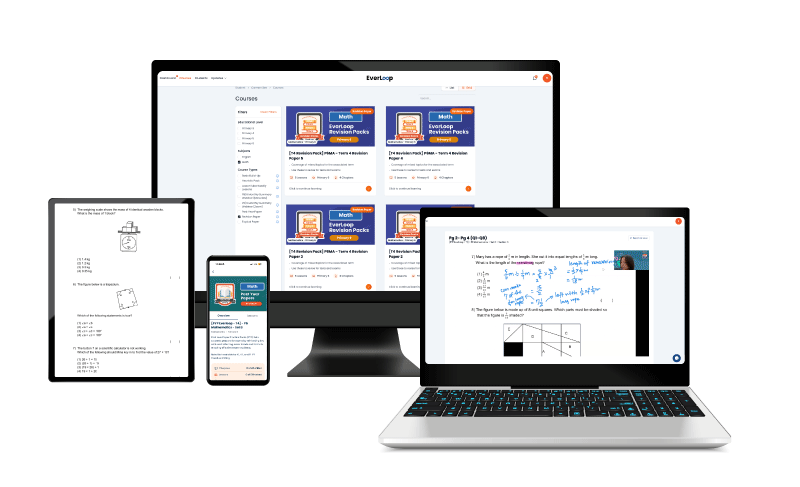
EverLoop revision resources shown across several devices

EverLoop After-Class Revision System
Complimentary with Every Enrolment

Primary Math students receive five EverLoop modules at no additional charge, alongside weekly lessons and AGrader’s in-house worksheets.

Past Year Paper Practice Packs (PYP)

Past Year Paper Practice Packs (PYP)

› To Practise Question Formats & Answering Techniques

Practice papers, teaching videos and detailed solutions give children more opportunities to revisit question types and check their working.

Basic Build-Up

Basic Build-Up

› To Strengthen Fundamental Concepts

Specially developed practice questions help children revisit core Mathematics concepts and strengthen their foundations.

Revision Packs

Revision Packs

› To Revisit Each Term’s Learning

Term-specific revision covers topics taught in Terms 1–4, giving children opportunities to identify gaps and practise weaker areas.

Topical Packs

Topical Packs

› To Practise a Specific Topic

Targeted practice papers and teaching videos offer additional explanations and practice for topics your child wants to revisit.

LessonTube

LessonTube

› To Catch Up or Revisit a Lesson

Lesson recordings let children return to missed lessons or revisit what was taught after enrolment.

Learn More

Meet Our Primary Math Curriculum Team

Teacher Felicia Tham

Teacher Felicia Tham

Felicia is a Math teacher and curriculum writer at AGrader. She graduated from the National University of Singapore with a double major in Economics and Psychology. With 10 years of teaching experience, Felicia is well versed in the primary Math syllabus. She has helped her students excel by helping them understand the problems in a systematic and clear manner. She is also well-liked by her students for being caring and patient.

Don’t Just Take Our Words For It
Check Out What Other Parents Said About Us

Enquire Now

Academic Year 2027 · Fees & Schedules

Find a P4 Maths Tuition Centre Near You

Looking for a Primary 4 Maths tuition centre in Singapore? Explore AGrader locations, check fees and schedules, and ask about available P4 classes at your preferred branch.

AGrader centre location map

Frequently Asked Questions

Useful answers about the curriculum, weekly lessons and home practice.

What does the Primary 4 Math syllabus cover?

Our P4 programme covers numbers to 100,000, rounding, factors and multiples, multiplication and division, fractions and the unit model, decimals to thousandths and their four operations, angles, squares and rectangles, nets, symmetry, area and perimeter, tables, line graphs and pie charts.

Which heuristics will my child learn in P4 Maths tuition?

Whole-number problem solving includes the Comparison Model, Stacking Model, Repeated Identity, Assumption, Before-and-After, Grouping and Systematic Listing. Children use the Unit Model and Comparison for fractions. Area and perimeter methods include Dividing into Parts, Difference, Cut and Paste, and Redrawing the Figure.

How do the P4 lessons help with fractions and decimals?

Children work with mixed numbers, improper fractions and fractions of a set, using the unit model to organise fraction word problems. Decimal lessons cover place value to thousandths, rounding, conversion between fractions and decimals, and the four operations. Worked examples lead into independent practice and a teacher-led review.

How long is each P4 Maths tuition class?

There is one two-hour lesson a week, with a maximum of 12 students per class. The P4 programme runs for 50 weeks across four terms. In AY2027, P4 lessons have grown from about one and a half hours to two hours, with the extra time used for more problem-solving practice and interactive teaching.

How does the programme support P4 Maths exam preparation?

Children receive termly revision and Diagnostic Tests in Terms 2 and 4, each followed by a go-through lesson for corrections and re-teaching. Revision Papers provide exam-style practice, and worked solutions show the steps that earn method and answer marks. EverLoop Revision Packs and Past Year Paper Practice Packs offer further practice.

What support is available between P4 lessons?

Each worksheet includes a 12-mark drilling section from AY2027. Summary Cheat Sheets, quizzes, QR-linked teaching videos and walkthroughs for harder questions and drilling sets help children revisit their work. Parents receive a weekly lesson summary, while LessonTube recordings and complimentary EverLoop resources support catch-up and revision.

Can I preview your Primary 4 Maths worksheets?

Yes. Use Download P4 Math in the learning-resources section to open the P4 Maths worksheets and materials preview linked from our Primary Math programme page.

Where can I find a P4 Maths tuition centre in Singapore?

Use Find a Centre to explore AGrader locations, then check View Fees & Schedules or enquire about P4 Maths tuition at your preferred branch. Preview the learning materials and ask about trial lessons before choosing a Primary 4 Maths tuition centre.

Let’s Talk About Your Child’s Next Step

Ask about the programme, current class availability and your preferred AGrader centre.

Enquire Now